
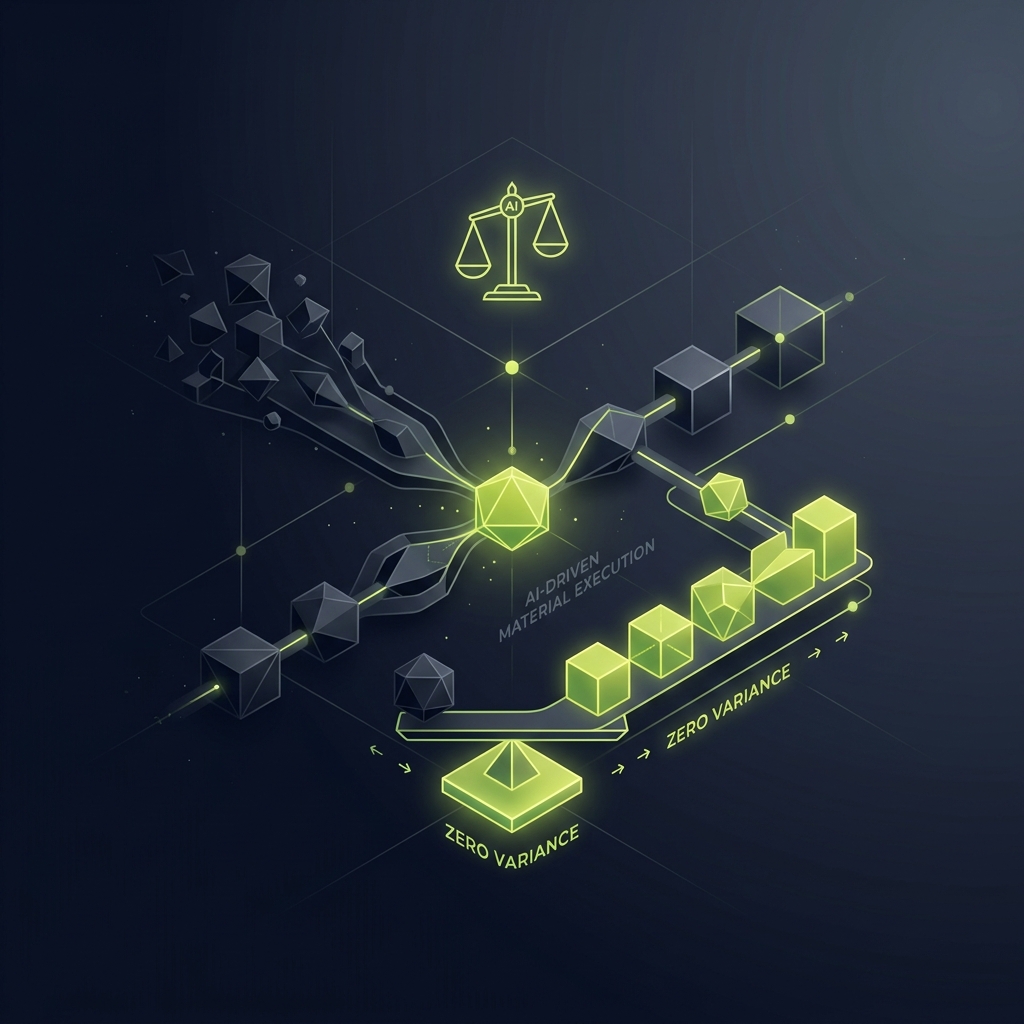
Towards Zero Inventory Variance
Digitally Controlled Material Execution
Industry: Automotive Component ManufacturingFocus: Inventory Accuracy • WIP Control • Material Traceability • Production ExecutionSolution: MES • RFID • Edge Devices • Industrial Handhelds • Digital Material Control
Problem Statement
Inventory Variance Was a Symptom of Uncontrolled Material Movement
In a complex discrete manufacturing environment, material continuously moves across raw material stores, production processes, WIP locations, SFG stages and final operations.
With multiple products following different and sometimes non-linear routings, material can move across several process modules before becoming a finished good. Bulk-processing operations such as chemical treatment and postponement-based SFG inventory add further complexity.
When physical material movement and digital inventory transactions are not synchronized, small gaps in identification, movement recording and production-order association can accumulate into significant inventory variance.
Business Objective
Create a digitally controlled material flow where every movement is authorized, every piece remains traceable and every inventory transaction is accountable—driving Inventory Variance towards Zero.
Challenges in the Current Process
Where Inventory Variance Begins
Complex RoutingDifferent finished goods follow different routes, making it difficult to manually determine whether material is at the right location, for the right production order and ready for the right operation.
Operator-Dependent MovementMaterial movement and routing decisions can depend heavily on operator knowledge and manual transactions, creating opportunities for incorrect movements.
Bulk ProcessingProcesses such as chemical treatment require multiple pieces to be processed together, making piece-level identity difficult to maintain.
FIFO ManagementFIFO can become dependent on manual identification and operator discipline when multiple lots or production orders are waiting for the same process.
Postponement & SFGCommon SFG inventory improves flexibility, but requires precise visibility of what SFG exists, where it is located and which production requirement it can fulfil.
Delayed Variance DetectionWhen movement is not controlled at the point of execution, discrepancies are often discovered only during periodic reconciliation—making the source difficult to identify.
A Digital Intelligence & Control Layer Around Existing Machines
Instead of replacing legacy machines, IdentifYou introduces a digitally interlocked material execution layer that connects the existing shop floor with MES, RFID, industrial handhelds and edge devices.
The MES understands the production order, routing, material identity, process status and destination.
When movement is required:
MES decides → Device instructs → RFID identifies → System validates → Material moves → Movement is confirmed → Inventory is updated
Before material is allowed to move, the system validates:
Only an authorized movement is permitted.
This changes material movement from a manual activity into a digitally controlled manufacturing execution event.
Designed for Legacy Manufacturing Environments
Legacy Machines + Digital Edge + RFID + MES = Connected Manufacturing Execution
This enables manufacturers to digitally transform material flow while protecting existing machine investments and minimizing disruption to production.
Control the Event That Creates the Variance
Inventory accuracy is engineered into the material movement process rather than checked only during periodic reconciliation.
Every critical inventory-changing movement follows a controlled cycle:
Identify → Validate → Authorize → Execute → Confirm → Update
IdentifyRFID readers, handheld scanners, or connected devices digitally identify the material, pallet, batch, or container at the point of movement.
ValidateThe MES validates the identified material against its production order, routing, current process status, quantity, and intended destination to ensure that the movement is correct.
AuthorizeThe system determines whether the movement is permitted. Only a valid, authorized material movement can proceed, preventing incorrect material, process, or destination movements.
ExecuteThe operator physically moves the material based on the digitally validated instruction, while the connected edge device captures the execution event.
ConfirmThe completed movement is digitally confirmed, creating a reliable transaction record linking the material, production order, process, location, and timestamp.
UpdateThe MES immediately updates the material's digital position and status, accurately reflecting whether it is in WIP, SFG, FG, or inventory.
Physical Material Position ↔ Digital Inventory Position
This enables the plant to prevent wrong movements at source, rather than discovering them later during reconciliation.
Production-Order-Based MovementMaterial is routed according to the production order and defined process sequence.
Digital InterlockingWrong material, wrong location, wrong process or wrong production order can be blocked before movement.
Piece-to-Batch-to-Piece TraceabilityBulk processes maintain the relationship between individual pieces, processing batch, production order and subsequent pieces.
System-Guided FIFOFIFO becomes part of execution logic rather than depending entirely on manual practice.
Postponement & Common SFGCommon SFG can be held at the appropriate decoupling point and converted into the required Finished Goods based on actual demand.
From Inventory Reconciliation to Inventory Accountability
Reduced Inventory VarianceControl material movement at the point of execution by validating every transfer against the production order, process, quantity, and destination—reducing the root causes of unexplained inventory differences.
Real-Time WIP VisibilityMaintain a continuously updated digital view of material across production stages, showing where the material is physically located, what process it is in, its quantity, and which production order it belongs to.
Wrong-Material Movement PreventionPrevent incorrect or unauthorized material movements before they occur by digitally validating the material identity, production order, routing, process status, and intended destination.
Improved Inventory AccuracyKeep physical material movement synchronized with digital inventory transactions, ensuring that every confirmed movement is immediately reflected in the corresponding WIP, SFG, FG, or inventory position.
Complete Material GenealogyCreate an end-to-end digital history of material movement across piece-level and bulk-processing operations, maintaining traceability from the original material through production, inspection, and finished goods.
Lower Variant-Specific InventoryEnable postponement strategies and common SFG inventory without losing material control or traceability, allowing production to respond more flexibly to demand while reducing the need to hold variant-specific finished inventory.
Stronger AccountabilityCreate a digital transaction trail for every material movement, making it possible to trace discrepancies back to the material, production order, process, location, movement, and execution event responsible.
Digitally Transform the Plant Without Replacing the Plant
IdentifYou combines MES, RFID, edge computing, industrial devices and manufacturing domain intelligence to create a digital control layer around existing production infrastructure.
It is about making them part of a connected, controlled and traceable manufacturing ecosystem.
Legacy Machines → Digital Connectivity → Controlled Material Flow → Real-Time Inventory Accountability
Every Piece. Every Movement. Every Order. Accounted For.
Towards Zero Inventory Variance
IdentifYou enables manufacturers to move from periodic inventory reconciliation to continuous inventory accountability—while extending the digital capabilities of their existing plant infrastructure.