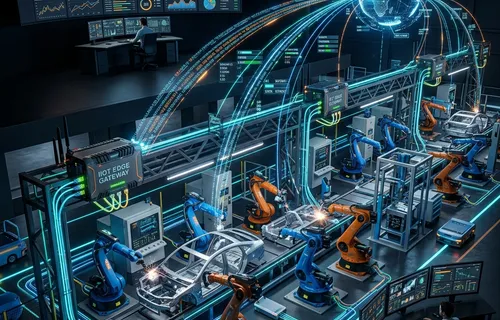

Towards Zero Inventory Variance
Digitally Controlled Material Execution for Real-Time Inventory Accountability
Industry: Automotive Component ManufacturingSolution: MES | RFID | Edge Devices | Material Traceability | Digital Production ExecutionBusiness Focus: Inventory Accuracy | WIP Control | Material Traceability | Production Execution
Problem Statement
Inventory Variance Was a Symptom of Uncontrolled Material Movement
In a complex discrete manufacturing environment, inventory does not remain stationary. It continuously moves between raw material stores, production processes, intermediate WIP locations, SFG stages and final processing operations.
With multiple finished goods following different and sometimes non-linear routings, material can move back and forth across several process modules before reaching the finished-goods stage.
The situation becomes more complex when different manufacturing processes use different material-handling methods. While most operations handle components piece by piece, processes such as chemical treatment may require components to be accumulated and processed in bulk.
A postponement strategy further introduces an intermediate SFG inventory point, where common material is held before being converted into different Finished Goods based on actual production requirements.
In such an environment, even small gaps in material identification, movement recording or production-order association can accumulate into significant inventory discrepancies.
The business objective
Establish a digitally controlled manufacturing environment in which every material movement is authorized, every piece remains traceable and every inventory transaction is accountable—driving inventory variance towards zero.
Where Inventory Variance Begins
Complex Routing
Different Finished Goods follow different process routes. Material may move between multiple process modules based on product, production order and process requirements.
This makes it difficult to manually determine whether a material is at the right location, for the right order and ready for the right operation.
Operator-Dependent Material Movement
Material movement decisions can depend heavily on operator knowledge and manual transactions. This creates the possibility of material being moved to an incorrect location or against an incorrect production order.
Bulk Processing
Chemical treatment and similar operations may require multiple pieces to be processed together. When material moves from piece-level handling to bulk processing, maintaining individual material identity becomes significantly more challenging.
FIFO Challenges
When multiple lots or production orders are waiting for the same process, FIFO can become dependent on manual identification and operator discipline.
Postponement Complexity
Holding common SFG inventory is strategically beneficial, but it introduces another control requirement: the plant must know exactly which SFG is available, where it is located and which Finished Goods production order it can fulfil.
Inventory Accountability
When physical movement is not digitally controlled at every critical transaction point, inventory discrepancies are often identified only during periodic reconciliation.
By then, identifying where, when and why the variance occurred can be difficult.
From Material Tracking to Material Control
The proposed solution establishes a digitally interlocked material execution system connecting the MES with RFID, industrial handheld devices and edge devices.
The MES becomes the intelligence layer that understands the production order, routing, material status and required process sequence.
When a movement is required, MES generates the appropriate instruction and communicates it to the relevant shop-floor device. RFID and handheld technologies identify the physical material, while edge devices capture and transmit operational events between the shop floor and MES.
Before the material is permitted to move, the system validates its identity, production order, current location, routing and intended destination.
Only an authorized movement is allowed to proceed.
The completed movement is then digitally recorded, allowing the MES to maintain an up-to-date representation of the physical material position.
The control principle
MES decides → Device instructs → RFID identifies → System validates → Material moves → Movement is confirmed → Inventory is updated
This transforms material movement from a manual activity into a controlled manufacturing execution event.
Combining Lean Manufacturing Principles with Digital Execution
Production-Order-Based Material Execution
Material movement is directly associated with the production order and its routing.
The system knows which material is required, which operation it needs to reach and which location is authorized to receive it.
This reduces the dependence on operator judgement for determining material destinations.
Controlled Material Flow & Digital Interlocking
The system creates a digital interlock between material, production order, process and destination.
If material is attempted to be moved to the wrong process, wrong location or wrong production order, the system identifies the mismatch and prevents the unauthorized movement.
The principle changes from:
Detect the wrong movement later
to:
Prevent the wrong movement at source.
Postponement & Common SFG Strategy
Instead of maintaining separate Finished Goods inventory for every variant, common processing is completed up to a defined SFG postponement/decoupling point.
Common SFG inventory can then be converted into the required Finished Good when the actual production requirement is known.
This supports:
Inventory pooling → Lower FG inventory → Greater flexibility → Reduced variant-specific inventory
The digital movement system ensures that the correct SFG is subsequently routed to the correct final processing operation.
FIFO-Based Material Management
FIFO is incorporated into the execution logic rather than being left entirely to manual practice.
The system can identify eligible material based on its availability, production order, process readiness and defined priority rules.
This helps prevent older WIP or SFG from remaining behind newer material and reduces unnecessary inventory ageing.
Piece-to-Batch-to-Piece Traceability
Where processes such as chemical treatment require bulk loading, the solution maintains the relationship between:
Individual Pieces → Processing Batch → Production Order → Process → Individual Pieces
This allows the plant to accommodate bulk-processing requirements without losing the digital identity of individual pieces.
Hybrid RFID + Edge Execution
RFID, handheld devices and edge devices are combined according to the nature of the shop-floor operation.
RFID enables rapid material identification and automated movement capture, handheld devices support operator-guided execution and confirmations, while edge devices provide the connectivity between physical operations and MES.
Control the Event That Creates the Variance
The most important principle behind the solution is:
Inventory accuracy should be engineered into every material movement rather than verified only during inventory reconciliation.
Every movement becomes a controlled digital event.
Identify
The material is digitally identified through RFID or handheld devices.
Validate
MES validates the material against its production order, routing, current status and destination.
Authorize
Only a valid movement is authorized.
Execute
The operator or device executes the approved movement.
Confirm
The actual movement is captured and transmitted to MES.
Update
The corresponding WIP/SFG/inventory position is updated digitally.
Reconcile
Physical material position and system inventory position remain continuously aligned.
The Zero Inventory Variance Control Loop
Physical Material
↓Identify↓Validate↓Authorize↓Move↓Confirm↓Update MES↓
Digital Inventory Position
This creates a continuous relationship between:
What physically exists in the plant
and
What the system says exists in the plant.
The closer every physical inventory-changing event is captured and controlled, the smaller the opportunity for unexplained inventory variance.
Strategic objective
Physical Inventory ≈ System Inventory
Inventory Variance → 0
From Inventory Reconciliation to Inventory Accountability
Reduced Inventory Variance
By controlling and digitally recording material movements, the plant can progressively reduce the sources of unexplained inventory differences.
Improved WIP Visibility
Production and plant leadership gain greater visibility into where material is physically located and what production order it belongs to.
Prevention of Wrong-Material Movement
The interlocked system prevents material from being moved to an unauthorized process or production order.
Improved Inventory Accuracy
Inventory positions are continuously updated through operational events instead of relying primarily on periodic manual reconciliation.
Improved FIFO Compliance
System-guided sequencing reduces dependency on manual FIFO management and helps minimize WIP ageing.
Lower Finished Goods Inventory
Postponement allows the plant to maintain common SFG inventory and delay final differentiation until the actual requirement is known.
Improved Production Flexibility
Common SFG can be dynamically allocated to downstream Finished Goods requirements without maintaining excessive variant-specific inventory.
Complete Material Genealogy
The plant gains a digital history of material movement across processes, including the relationship between individual pieces and bulk-processing batches.
Stronger Accountability
Inventory discrepancies can be traced back to specific material movements, production orders, locations, processes and transactions, making it easier to identify the source of variance.
Every Piece. Every Movement. Every Order. Accounted For.
What began as a material movement challenge becomes a broader inventory accuracy and manufacturing execution strategy.
Production Order→ Material Identification→ Routing Validation→ Movement Authorization→ Process Execution→ Traceability→ Inventory Update→ Accountability
Business Outcome
By controlling material movement at the point of execution and maintaining continuous digital traceability, the solution creates the foundation for real-time inventory accountability and drives the organization towards its strategic objective of Zero Inventory Variance.
Towards Zero Inventory Variance
When every movement is controlled, every piece is traceable, and every inventory event is accountable.
IdentifYou enables manufacturers to connect production orders, MES, RFID, edge devices and shop-floor execution into one digitally controlled material flow—turning inventory accuracy from a periodic reconciliation exercise into a continuous manufacturing discipline.
| From | To |
|---|---|
| Operator-driven movement | System-controlled movement |
| Manual routing decisions | MES-driven routing |
| Periodic inventory reconciliation | Event-driven inventory control |
| Material tracking | Material authorization + tracking |
| Process-level traceability | Piece-level traceability |
| Bulk processing with traceability gaps | Piece-to-batch-to-piece genealogy |
| Manual FIFO | System-guided FIFO |
| Variant-specific FG inventory | Common SFG + postponement |
| Variance discovered later | Movement controlled at source |
| Inventory discrepancy investigation | Movement-level accountability |