Zebra Line Inspection
Industry: Glass Manufacturing · Application: On-Line Glass Inspection · Technology: Dual-Path Optics + Vision AI + Edge Acceleration
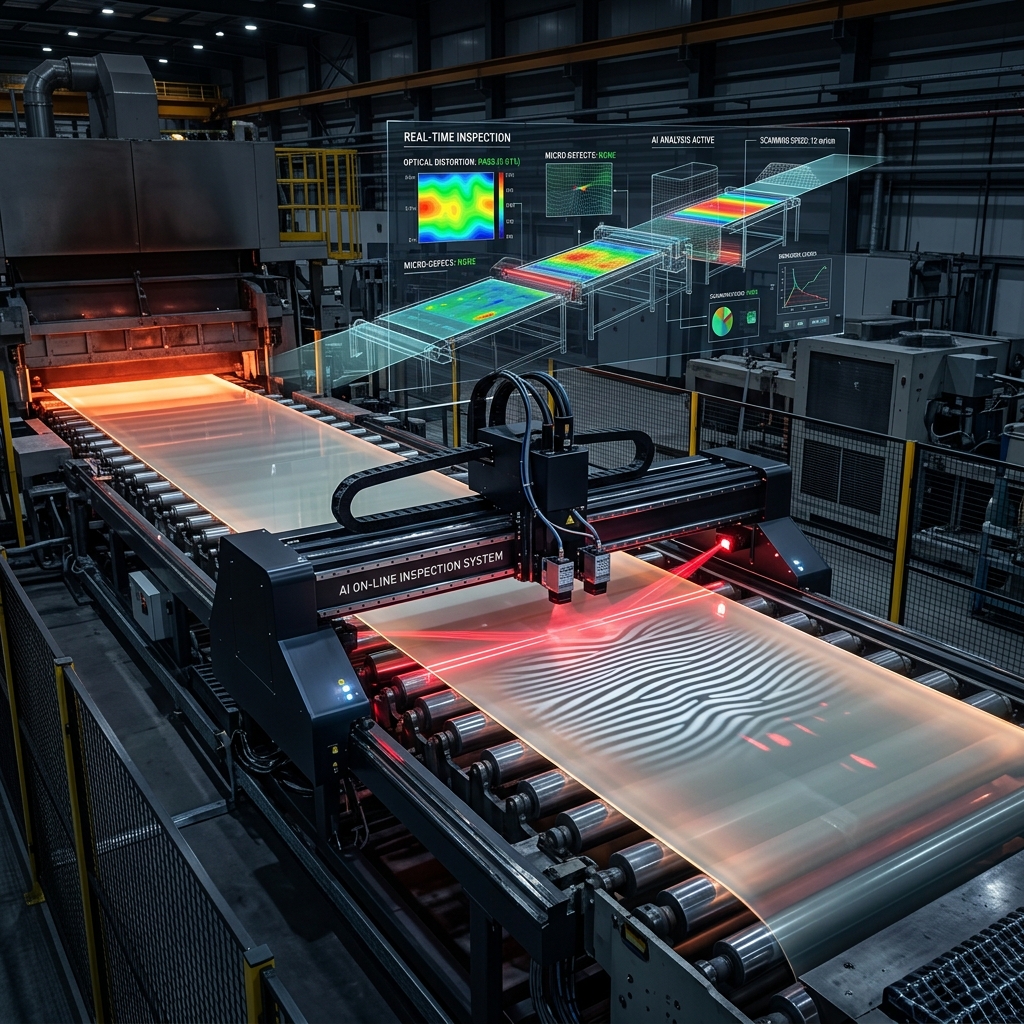
In the glass manufacturing industry, image distortion and surface defects are inherent physical realities. As glass undergoes tempering, heat-strengthening, and environmental shifts (temperature, barometric pressure, and wind loads), maintaining optical quality is a critical challenge.
This case study examines the transformation of an automated Floating Glass On-Line Inspection System from a purely deterministic, rule-based setup into a next-generation AI-Powered Edge Vision Platform. By upgrading advanced optical hardware (Camera and Laser systems) with Deep Learning (CNN) classification, generative adversarial networks (GANs) for synthetic defect training, and real-time semantic segmentation, the system achieves unprecedented precision in micro-defect localization and macro-distortion analysis. This modern framework blends deterministic, safety-critical MISRA-C and NI LabVIEW execution with cloud-to-edge machine learning pipelines.
Glass companies universally acknowledge that image distortion is a baseline fact of production. However, legacy machine vision systems rely on strict, manually configured pixel-threshold rules. These hard-coded formulas struggle to keep pace with high-speed modern production lines and the complex, subtle variations within the four core defect categories:
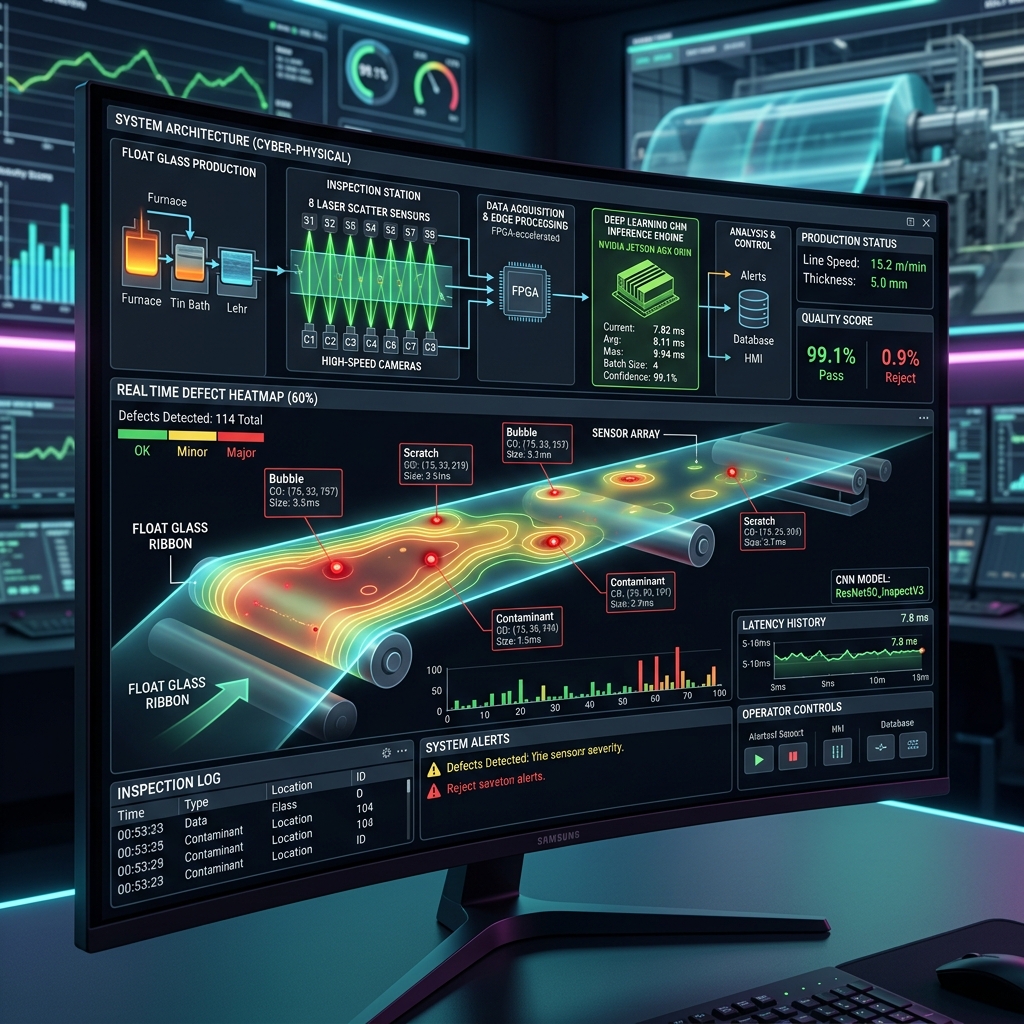
Figure 1: Cyber-Physical AI Inspection Architecture integrating laser scattering, LabVIEW determinism, and PyTorch deep learning (<10ms).
To achieve comprehensive quality assurance, the modern solution injects an AI layer directly into the dual-path hardware infrastructure, creating a multi-modal, deep-learning-driven inspection engine.
The physical sensors are retrofitted to serve as high-fidelity data feeds for computer vision models:
Raw images are processed by a uniquely coupled dual-engine architecture designed for industrial speed and adaptability:
| Defect Category | Traditional Identification Challenge | Modern AI Solution Approach |
|---|---|---|
| 1. Discrete Defects (Bubbles, stones, knots) | Hard to distinguish from transient surface dust using traditional grayscale thresholds. | Convolutional Neural Networks (CNNs) classify internal vs. external defects via depth-of-field shadow analysis. |
| 2. Dimensional Defects (Size, thickness, shape) | Point-checking sensors miss progressive, multi-axis tapering or edge warping. | Continuous Spatial Regression Models map volumetric irregularities across the entire moving glass ribbon. |
| 3. Distortion Defects (Refractive index, contours) | The mathematical parabolizing of zebra lines struggles with complex, overlapping wave patterns. | Deep Optical Flow & Transformer Networks predict and isolate complex, non-linear lens distortions in real time. |
| 4. Surface Defects (Scratches, dimples, chatter) | Microscopic scratches under 50 μm lack contrast, causing false negatives or high false-alarm rates. | Semantic Edge Segmentation (e.g., U-Net architectures) maps and highlights micro-fissures at the pixel level. |